
What the room is carrying
By the time a conversation begins, the room has already started shaping what can happen there. People arrive carrying what the room has taught them to expect. The last conversation is in the room. So is the old disappointment. The promise that sounded good and never became real. The quiet question too: is it safe enough to be honest, and will honesty matter if I offer it?
This is what we mean by what the room is carrying.
I have been watching this for years. People find their place before anyone says much of anything. Around a leadership table, someone returns to the same chair. At a family dinner, someone reaches for the seat they have always taken. We move toward what steadies us and away from what unsettles us, often into roles the room already knows how to make available. Over time, it can become hard to know whether we are shaping the room, or the room is shaping us.
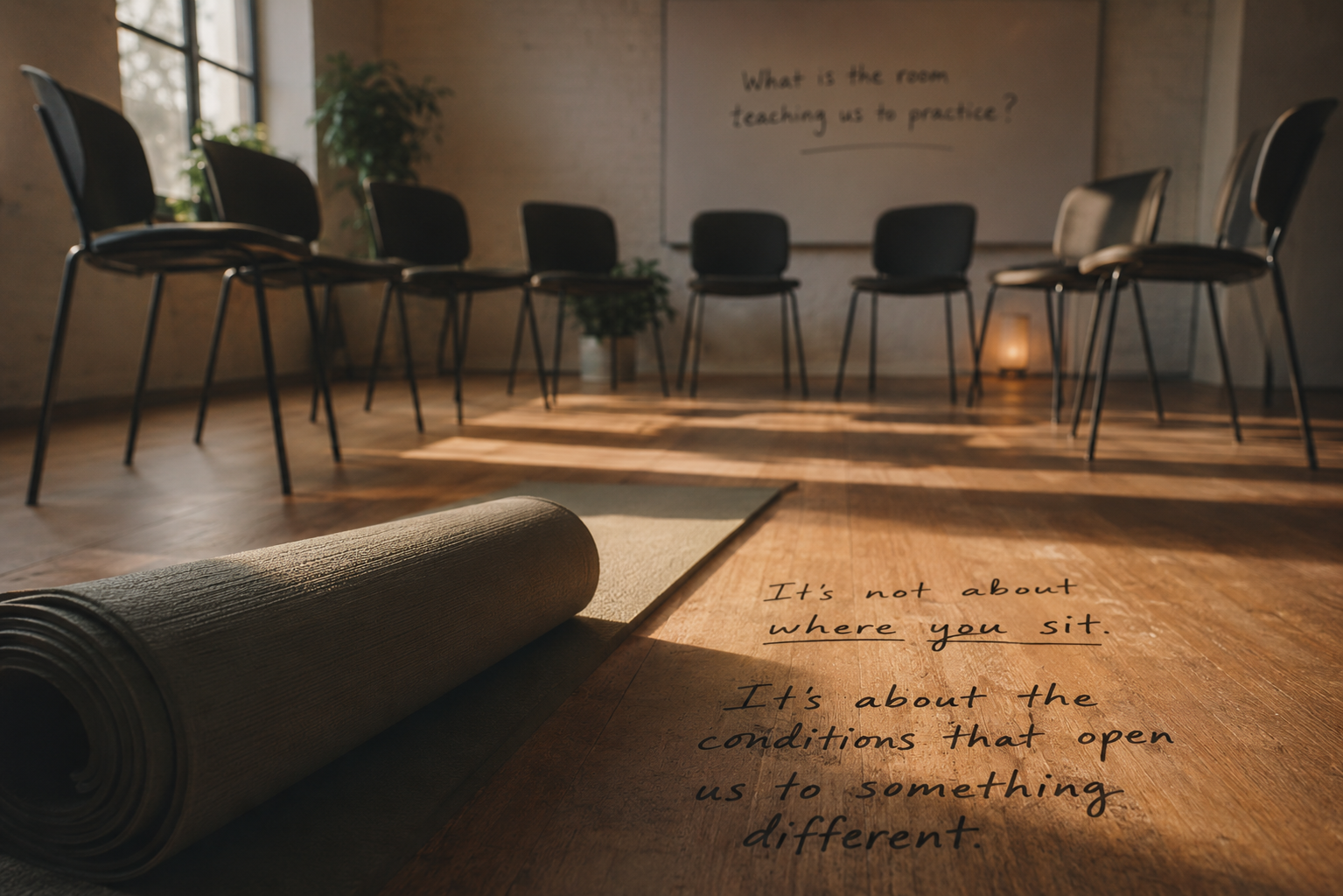
Years before I had language for this in dialogue, I felt it in a yoga room. I had a spot I loved. Everyone knew it. My classmates and teacher even called it my spot. From there, the angle to the teacher felt right. The mirror was close enough to orient me. I could feel present without feeling too exposed. That spot helped me settle. It felt like the place from which I could do my best work.
And then one day, my teacher put a stop to it. She told me that, from then on, I could not put my mat in the same place two classes in a row.
Excuse me?
This was no small thing to me. I had chosen that spot for a reason. I thought the comfort of it would help me go deeper. I think she wanted the same thing for me. We just had different ideas about what would make that possible.
But there I was in a new spot every class. Her voice came from different directions. The mirror was no longer where my body expected it to be. I had to find my balance without the same familiar references. Slowly, I understood that I had been practicing more than just my yoga routine in that spot. I had also been practicing the habits of that spot. The room had been helping me repeat myself.
I think about that often in dialogue. I also want to be careful with the metaphor. The “spot” in the room is the surface. The deeper question is what the room has trained people to expect, and whether the design of the dialogue can create enough space for a different response.
A person can sit in the same place and still encounter the room differently. A group can remain around the same table and begin to relate in a new way when the conditions are strong enough to hold competing realities without rushing them into one clean story. This is part of the discipline of Multarity Thinking®: creating conditions where complexity can become clear enough to work with, and where people can begin to see what has been shaping them, what has been separating them, and what else may be possible now.
A room can look calm while working hard to protect itself. People may seem polite and responsive. Underneath, they may be deciding whether the process can be trusted, whether it is worth saying the thing they have tried to say before, or whether the familiar role they are playing is the only one available to them.
At Future of Dialogue, we listen for the room as much as we listen to the words. We listen for the pattern underneath the comments, the moment when language tightens, and the place where a simple question lands with unexpected weight. We listen for what the room has taught people to expect, and for what keeps repeating because it has not become clear enough to work with.
Dialogue cannot begin and end with giving people a chance to speak. Speaking matters. Being heard matters. The deeper work asks us to notice the conditions around the speaking. Sometimes care arrives as resistance because it has nowhere clean to go. Sometimes silence is protection. A repeated story may be the room asking again to receive what it has not yet been able to hold.
When a room begins to see what it is carrying, the conversation changes. The hard thing may still be hard, and people may still disagree. The history does not vanish. But the room now has a truer place to begin.
A leader may realize the communication problem is really a trust problem. A group may recognize that the tension is older than the decision in front of them. A community may begin to understand that the pattern it keeps repeating is not accidental.
Without that recognition, groups can mistake activity for movement. A group can revise the plan, restate the values, and name next steps that sound thoughtful and necessary. For a while, this can feel like progress. Then the same pattern returns, because the room has tried to change what it does while leaving the deeper dynamics untouched.
What the room is carrying will shape what the room can do.
That is why the work begins before the first question is asked. It begins with how the room is held, and with the conditions that help people notice what they have been practicing together, often without knowing it.
That is part of the practice: noticing where we keep putting the “mat” down, then creating the conditions where people can meet the same room with a different kind of awareness.
We can choose differently when we can see what the room has been teaching us to practice.
