
Turning Dialogue into Usable Insight
I’ve been thinking lately about the mistake we make when we treat the conversation as the whole thing.
I understand why we do it. The conversation is the part that takes up space in our memory. People gather. Words are spoken into the room. Maybe someone takes notes. Maybe some decisions are made. Maybe we leave feeling as though we got somewhere. Later, we can point back to the meeting, the forum, the listening session, the retreat, the town hall, or the strategic process, and say, that was the conversation.
““There is the conversation everyone hears, and there is the conversation the room is carrying.”
I have built so much of my life around the belief that people need rooms where they can speak honestly and be heard with care. And I have also learned that spoken conversation is rarely where the whole truth lives. I do not say that lightly. Thirty years in schools, organizations, communities, leadership teams, public gatherings, and hard conversations will teach you a great deal about meetings. It will also teach you that meetings often teach very little when they stay on the surface.
The reality is that people are tired of meetings. Organizations have tried to solve the exhaustion by shortening the agenda, sending the update by email, clarifying who gets to decide, or finding a better facilitation method. Some of that helps. Anything that respects people’s time and attention matters. And still, something deeper often remains untouched.
The deeper issue is that we keep treating the time we spent together as though it contains the whole reality of the room. It rarely does.
There is the conversation everyone hears, and there is the conversation the room is carrying. Sometimes those two things are close together. Often, they are not. That gap is where this work begins to matter.
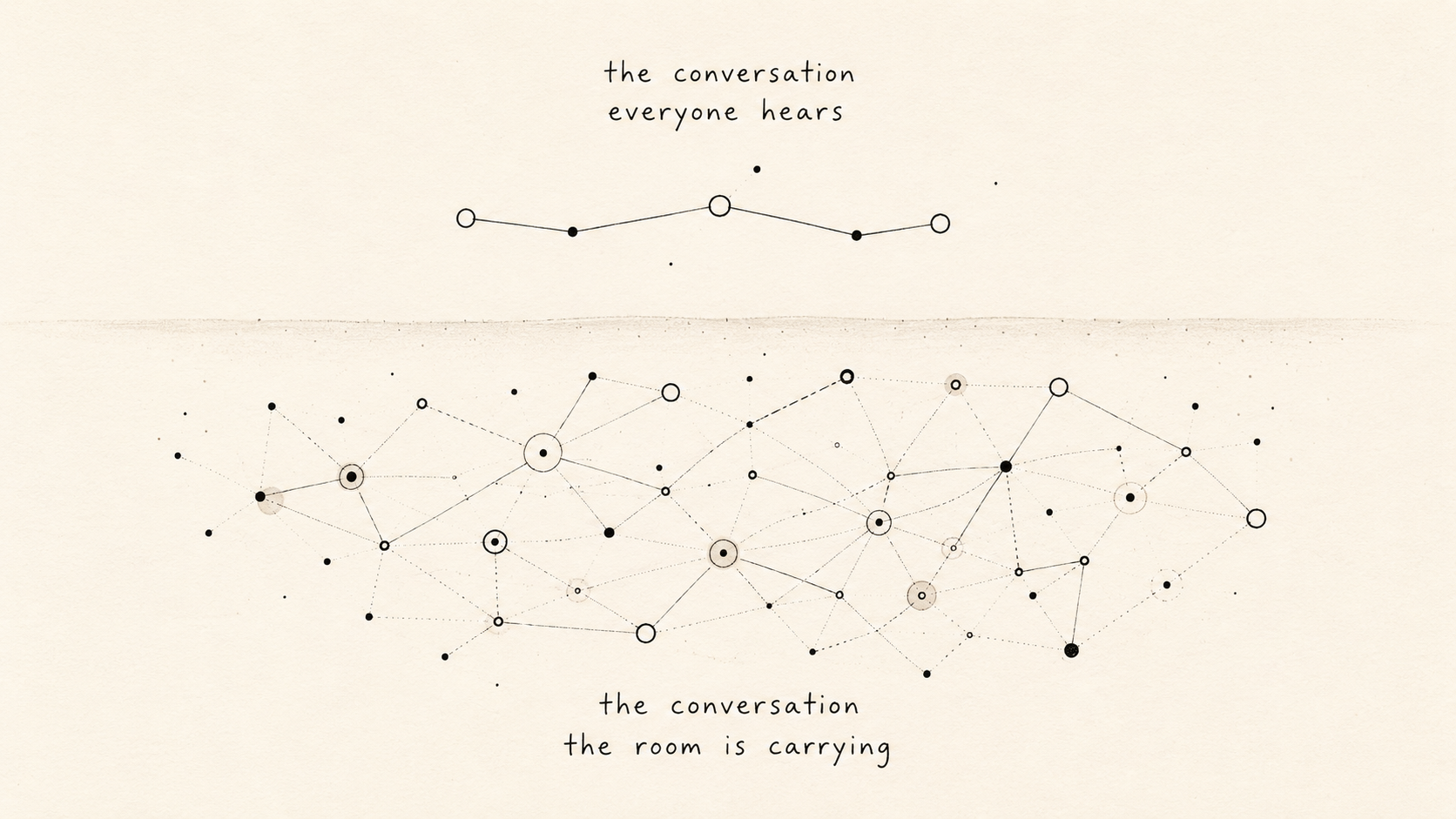
A group can talk for a long time and still never touch the thing shaping the room. People can be sincere, articulate, passionate, and even vulnerable, and still leave the deepest tension unnamed. They can agree on language while quietly disagreeing about meaning. They can circle around the same concern for months because no one has found a way to say what is actually underneath it.
That is the part we keep listening for: the underneath, the human reality that has been really shaping the room. Sometimes you can feel it before anyone is able to name it. The room has a charge to it. People are measuring their words, watching who responds, trying to say enough without saying too much. What looks like hesitation may carry a long history of learning what happens when honesty costs too much.
Those moments are easy to miss when we are listening only for content. We hear the concern, and we move too quickly toward response. We explain, defend, summarize. We even try to move forward. Sometimes moving forward too quickly is how a group avoids seeing where it actually is.
That is one reason dialogue can leave people feeling strangely unfinished. Everyone may have spoken. People may have listened. There may even be agreement in the room. And still, something lingers. The meeting ends, the notes are cleaned up, the next steps are named, and some part of an intuitive group knows the real thing was near the surface and never fully seen. At Future of Dialogue, that is where our attention goes. We listen for what shapes the conversation before it becomes language: assumptions, thinned trust, hidden loyalties, and the tensions a group has learned to move around because naming them feels too risky.
This is delicate work. You cannot force it out of people. People reveal what they are carrying when the conditions allow for it. They need enough safety to stay present, enough structure to keep from scattering, and enough reflection to begin seeing the pattern while they are still inside it.
This is where dialogue becomes usable. A conversation can open something, and then people need a way to return to what was opened. They need language for it. They need a map of it. They need a shared artifact that helps them remember what became visible and why it mattered. That takes a different kind of system around the conversation, one that can hold the human complexity of the room, listen for patterns and meaning as they emerge, and return something people can use to make wiser choices after the room empties.
Conversation is only the surface. The deeper work is creating the conditions for a room to see itself while there is still time to choose differently.
